Montana Minimum Wage 2027: $11.20 an Hour From January 1
Montana's minimum wage rises to $11.20 an hour on January 1, 2027, with no tip credit.
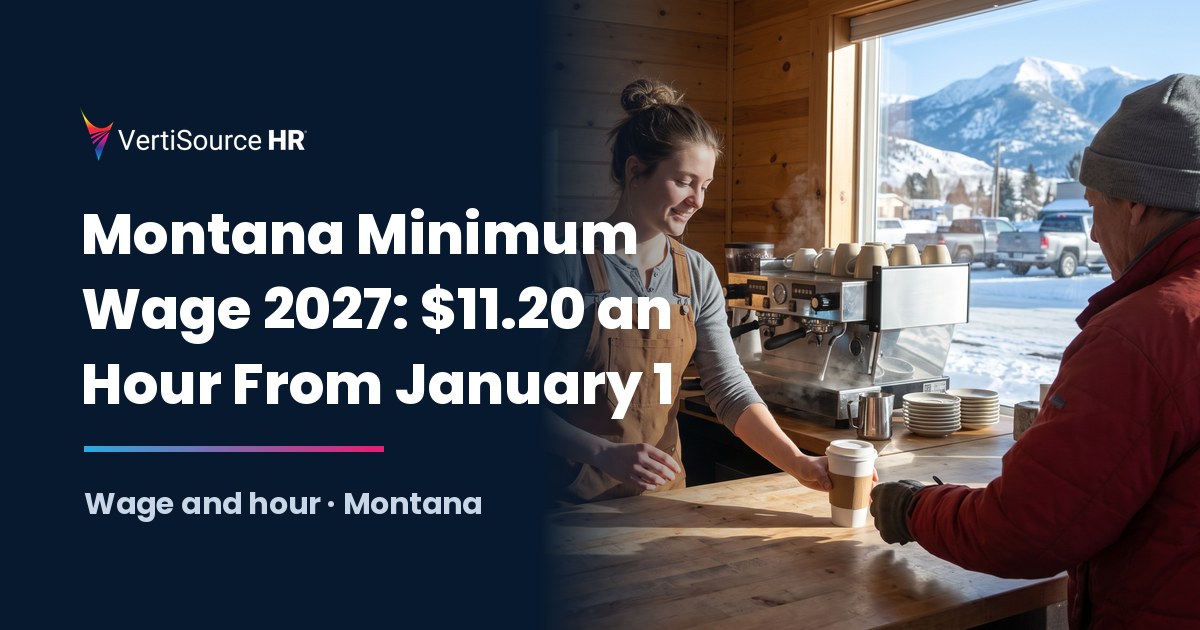
Montana’s minimum wage rises from $10.85 to $11.20 an hour on January 1, 2027. It generally covers employees working in Montana, and covered tipped employees are owed the full rate too, because Montana allows no tip credit.
What changes on January 1, 2027?
The Montana Department of Labor & Industry lists the current minimum wage as $10.85 and the rate effective January 1, 2027 as $11.20.
This is not a new law. It is the state’s annual cost-of-living adjustment under Montana Code Annotated 39-3-409.
The statute says the adjustment must be made no later than September 30 each year, based on the increase, if any, in the consumer price index from August of the preceding year to August of the current year. The new figure is rounded to the nearest 5 cents and takes effect the following January 1.
Who has to pay $11.20?
The department’s wage and hour reference guide says the Montana Minimum Wage Law applies to all workers in Montana, unless the law provides a specific exemption.
The department also states that Montana’s minimum wage is the greater of the federal or the current Montana minimum wage. The U.S. Department of Labor puts the federal minimum at $7.25 an hour. Because $11.20 is higher, it is generally the rate to pay for covered work in Montana from January 1, 2027.
Is there a small business exception?
Yes, but it is narrow. The department states that a business not covered by the Fair Labor Standards Act (FLSA) whose gross annual sales are $110,000 or less may pay $4.00 an hour.
Even inside such a business, the department says an individual employee who produces or moves goods between states, or is otherwise covered by the FLSA, must be paid the greater of the federal or Montana minimum wage. A business covered by the FLSA cannot use the $4.00 rate.
Montana law also exempts some kinds of work from the state minimum wage, such as certain students, the employer’s immediate family members and bona fide executive, administrative or professional employees. The student exemption covers students in a distributive education program set up under an accredited educational agency, and it and some other exemptions need the department’s prior approval. The department’s guide lists them and invites employers to call the Wage and Hour unit when coverage of a worker is unclear.
Can tips count toward the minimum?
No. Montana does not allow a tip credit. The department states that no tip credit, meal credit or training wage is allowed under Montana’s wage and hour laws, and its guide says tips belong to the employee and cannot be used to make up any part of the wage. For food, beverage and lodging businesses, the rule covers fixed charges added to a customer’s bill instead of a tip, which must be distributed to eligible nonmanagement employees and cannot count toward minimum wages.
So a covered Montana server, bartender or valet is generally owed at least $11.20 an hour in wages from January 1, 2027, before any tips.
What about overtime?
Under the federal Fair Labor Standards Act, covered employees who are not exempt must receive at least time and one-half their regular rate for hours over 40 in a workweek. Montana’s guide sets the same rule under state law, unless an employee is specifically exempt. Overtime and the minimum wage are checked one workweek at a time, and the guide says hours cannot be averaged over two or more weeks. For example, a covered nonexempt employee paid only $11.20 an hour is owed at least 1.5 times that rate for each hour over 40 in a workweek.
What should employers do, and by when?
On the poster: the department calls it an optional posting it recommends, so it does not replace any notice you are required to post. HRMorning reports the same.
Also look at employees just above the old minimum. The minimum wage sets a floor, so it does not move anyone already at $11.20 or more. But a senior hourly worker who now earns only a few cents more than a new hire is a pay decision worth making on purpose.
What if most of my staff are in another state?
The Montana rate generally still applies to people who work in Montana, and many states set their own minimum wage, so a multi-state payroll can carry several floors. Our guide to California local minimum wages shows how many city and county rates can apply within one state, and our overview of California minimum wage changes for 2026 describes the statewide, local and industry rates that took effect January 1, 2026.
Montana’s next adjustment, if the consumer price index rises, is due by September 30, 2027 and would take effect January 1, 2028.
How VertiSource HR handles this for clients
We update clients’ Montana payroll rates for January 1, 2027 and make sure payroll and payroll tax work is done on time. For clients on our time and attendance, approved timesheets flow into the next payroll run with overtime calculated by state.
Primary sources: Montana’s Minimum Wage, Montana Department of Labor & Industry; Wage and Hour Labor Law Reference Guide, Montana Department of Labor & Industry; Montana Code Annotated 39-3-409; U.S. Department of Labor, Minimum Wage; U.S. Department of Labor, Overtime Pay. Last reviewed November 16, 2026.
Questions employers ask
Can I pay tipped employees in Montana less than $11.20 an hour?
Can a small business in Montana pay $4.00 an hour?
Does the federal $7.25 minimum wage apply in Montana?
Disclaimer: This content is for general informational and educational purposes only and does not constitute legal, tax, accounting, or professional advice. Consult a qualified attorney or licensed advisor before making employment, payroll, or compliance decisions. VertiSource HR disclaims all liability for actions taken or not taken based on this material.
Have a question on this?
Talk to the VertiSource HR specialist who handles legal news & compliance work every day. No script, no sales drip.
Get your free HR review