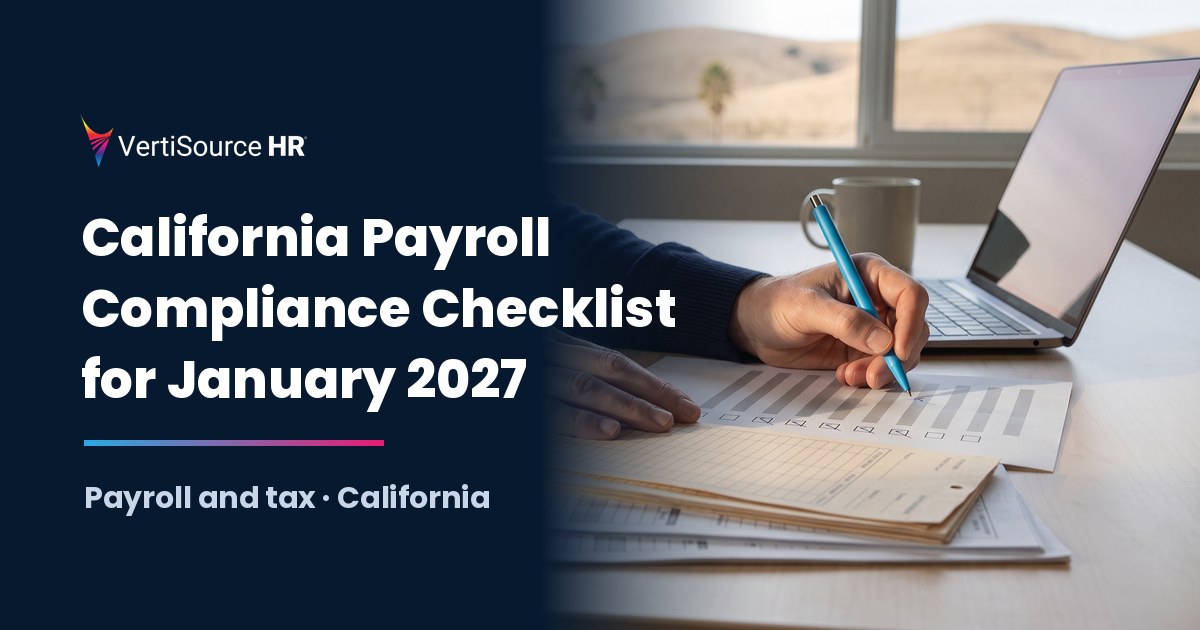
California Payroll Compliance Checklist for January 2027
California's 2027 minimum wage, exempt salary and tax rates, plus the payroll checks to run every year.
Beginning January 1, 2027, California’s statewide minimum wage will increase to $17.40 per hour, says the California Department of Industrial Relations (DIR). That sets the minimum salary for California’s standard executive, administrative and professional exemptions at $72,384 a year; the employee must also meet the duties and other requirements of the specific exemption, and some occupations and industries have different requirements.
January 2027: which minimum wage applies?
Identify where each employee actually works and whether a covered fast food or health care rule applies, then assign the highest applicable rate.
| Location or employer | Minimum | Effective |
|---|---|---|
| California statewide | $17.40 | Jan. 1, 2027 |
| San Diego (selected local example) | $18.35 | Jan. 1, 2027 |
| Palo Alto (selected local example) | $19.25 | Jan. 1, 2027 |
| Covered fast food | $20.00 | Since April 1, 2024; verify 2027 |
| Covered health care | $19.28 to $25 | By facility; some rise July 2027 |
DIR says some cities and counties set higher local rates; our local minimum wage guide lists the July 1, 2026 local increases.
Contractors’ and subcontractors’ employees providing health care or supporting services generally qualify for the health care minimum wage for those hours if their employer contracts with the covered facility, directly or through a contractor, for that work, and either the facility engages them or controls their wages, hours or working conditions, or they work more than half of a workweek on its premises. Delivery, waste collection and medical transportation workers are excluded when their employer does not own, control or operate a covered facility.
January 2027: salaried under $72,384?
- Flag exempt salaries under $72,384 or the industry floor.
- Duties and other requirements must also be met.
- By January 1, 2027, raise those who pass to at least that line, or reclassify as nonexempt.
- Record the change and give any required written wage notice.
For covered health care employees, an exempt salary must be at least 1.5 times the health care minimum wage or two times the state minimum wage, whichever is greater (Labor Code section 1182.14).
For employees covered by Labor Code section 2810.5, DIR’s wage notice FAQ says a change to the notice’s information generally needs written notice within seven calendar days, unless a timely wage statement or another writing required by law gives it. If a rate increase is the only change and the next pay stub shows the new rate, no notice is needed.
Effective January 1, 2027, DIR has adjusted the computer software exemption minimums to $61.03 an hour, $10,592.37 a month and $127,108.34 a year; its other requirements still apply.
January 2027: tax rates and postings
The 2027 ETT rate stays at 0.1 percent, says EDD, but enter the rates on your own 2027 rate notice (DE 2088), which EDD says also tells you whether you are subject to ETT. For employees subject to SDI, update withholding from 1.3 to 1.4 percent for 2027, with no taxable wage cap.
Post the statewide minimum wage order and your industry wage order from DIR’s postings page; covered fast food and health care employers also post DIR’s supplement.
Every year: overtime and breaks
For most nonexempt adults, DIR says overtime is:
- Daily: 1.5x the regular rate after 8 hours, 2x after 12.
- Weekly: 1.5x after 40 hours.
- Seventh consecutive workday of a workweek: 1.5x for the first 8 hours, 2x after that.
The regular rate includes shift differentials, commissions and nondiscretionary bonuses. Payroll check: test a nondiscretionary bonus in an overtime week and confirm overtime uses the regular rate.
A workday over five hours generally needs a 30-minute meal period with all duty relieved by the end of the fifth hour, and a day over ten hours a second by the end of the tenth, subject to limited waivers by mutual consent.
Nonexempt employees generally get a paid net 10-minute rest break per four hours worked or major fraction, which employers must authorize and permit; DLSE counts anything more than two hours as a major fraction of four, and none is required under 3.5 hours a day.
In Donohue v. AMN Services (2021), the California Supreme Court barred rounding time punches for meal periods and held that time records showing missed, short or delayed meal periods with no premium paid create a rebuttable presumption of a violation (see what a late lunch can cost).
Operator insight
Payroll check: confirm meal punches are not rounded and that each short, late or missed meal in one pay period has a premium or a documented reason none was owed.
Every year: are your pay stubs complete?
Mark one real stub against the Labor Commissioner’s sample hourly pay stub (Labor Code section 226(a)) for:
- The employer’s legal name and address.
- The employee’s name and only the last four Social Security digits or an employee ID number.
- Pay period dates, gross and net pay, and all deductions.
- Each hourly rate with the hours worked at that rate, and total hours worked (not required for salaried exempt employees).
- Available sick leave, or a separate statement with it on payday.
Every year: does sick leave meet the minimums?
State sick leave at a glance
- 30 days of work for one employer within a year in California makes an employee eligible, with narrow exceptions; use can start on day 90.
- 1 hour per 30 hours worked is the standard accrual; other schedules must reach 24 hours by day 120 and 40 by day 200.
- 40 hours or five days a year, whichever is more, is the lowest allowed use limit.
Check local paid sick leave ordinances too: DIR says that, in general, an employer subject to one must comply with both the local and state laws and give the most generous provision, though state law controls on topics such as pay stub statements and timing of sick pay.
Can payroll errors lead to PAGA penalties?
Yes. The Private Attorneys General Act lets employees sue to recover civil penalties for Labor Code violations on behalf of the state, says the Labor and Workforce Development Agency. Review payroll records against the checks above and correct problems before an employee notice arrives.
Year-end preparation and upcoming deadlines
How VertiSource HR handles this for clients
Our time and attendance feeds our payroll: managers approve timesheets each week, approved time flows into the next payroll with overtime calculated under California rules, the clock prompts meal and rest breaks, and every timesheet edit is logged. Each client’s own payroll specialist makes sure it is paid.
Check overtime and breaks before January
Our free check looks at how you pay overtime and breaks, at no cost to you.
Request the free check See our payroll servicesFirst reviewed October 16, 2026; last reviewed November 11, 2026.
Questions employers ask
Does the $72,384 salary threshold that starts January 1, 2027 apply to every exempt employee?
What premium pay is owed for meal or rest break violations?
We ended the job the day an employee gave two weeks’ notice. When is final pay due?
Disclaimer: This content is for general informational and educational purposes only and does not constitute legal, tax, accounting, or professional advice. Consult a qualified attorney or licensed advisor before making employment, payroll, or compliance decisions. VertiSource HR disclaims all liability for actions taken or not taken based on this material.
Have a question on this?
Talk to the VertiSource HR specialist who handles california compliance work every day. No script, no sales drip.
Get your free HR review