SB 1149 Expands California Bereavement Leave in 2027
SB 1149 adds a designated person to California bereavement leave in 2027, plus four other new laws to know.
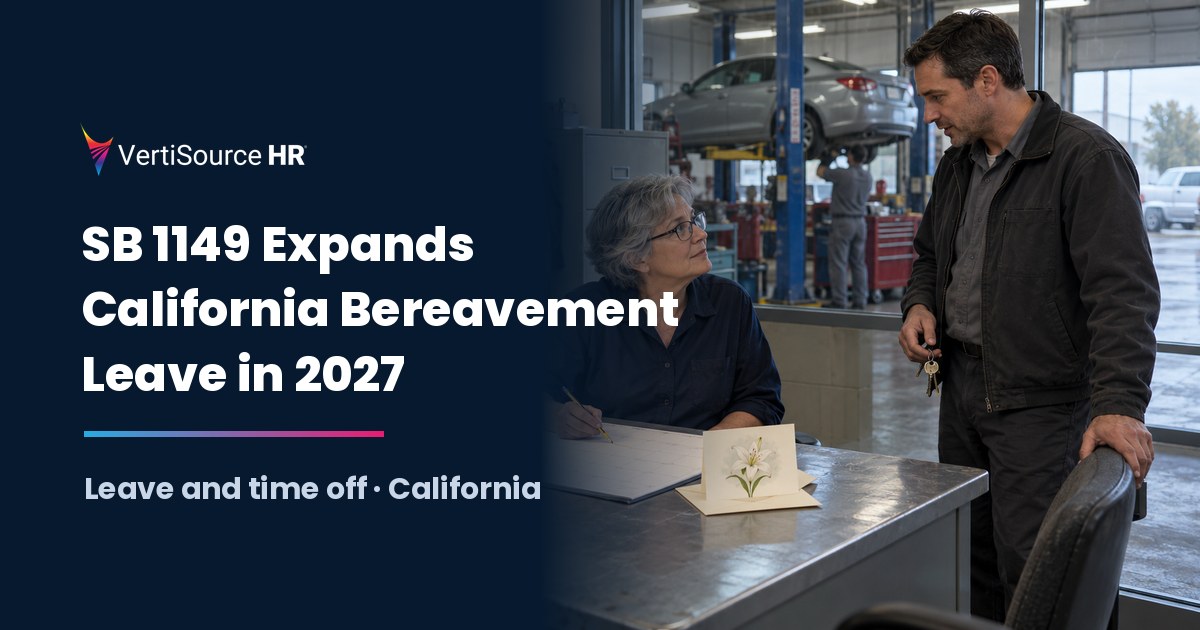
From January 1, 2027, California private employers with five or more employees, and state and local government employers, must allow bereavement leave for the death of a designated person. That is in addition to a listed relative, and under Government Code section 12945.7 the state, cities, counties and other public employers are covered at any headcount.
| Law | Who it reaches | Key date |
|---|---|---|
| SB 1149: bereavement leave | Covered employees who lose a designated person | January 1, 2027 |
| SB 1237: pay data penalty | Employers required to file a pay data report | May 12, 2027 report, the first under the higher cap |
| AB 2646: farm minimum wage | Approved agricultural employees and corresponding employees | January 1, 2027: $19.75 plus the 3.6% adjustment |
| AB 1697: stay-or-pay delay | Employers using repayment agreements | In effect now; ban covers contracts from January 1, 2027 |
| AB 1803: hate speech training | Employers regularly employing 5+ people or regularly using 5+ contractors | January 1, 2028 |
Bereavement leave from January 1
SB 1149 rewrites the list of family members in Government Code section 12945.7.
A designated person is anyone related to the employee by blood, or whose association with the employee is the equivalent of a family relationship. The employee may name that person when requesting leave, and an employer may limit an employee to one designated person per 12-month period. Government Code section 12945.2 defines “parent” to include a parent-in-law. So a parent-in-law stays covered as a parent and does not use up the employee’s one designated person.
Featured takeaway
The law does not require pay; the leave follows your existing bereavement policy. With no policy, the leave may be unpaid, though the employee may use vacation, personal leave, accrued and available sick leave, or comp time otherwise available to them. If your policy pays fewer than five days, the employee still gets five days in total, and the rest may be unpaid on the same terms.
The leave generally covers employees with at least 30 days of service before it starts, with an exception for some union contracts. The five days need not be consecutive and must be completed within three months of the death. If you ask, the employee must document the death within 30 days of the first day of leave. That can include a death certificate, a published obituary, or written verification of death, burial or memorial services from a mortuary, funeral home, burial society, crematorium, religious institution or governmental agency. You must keep confidential the identity of any employee who requests the leave, and share their documentation only with internal personnel or counsel as necessary, or as law requires.
You may not fire, demote, fine, suspend or otherwise discriminate against an employee for taking the leave (section 12945.7(g)). Bereavement leave is a right separate and distinct from family care and medical leave (CFRA) under section 12945.2 (section 12945.7(j)), so it does not count against an employee’s CFRA leave.
Pay data penalties
The Civil Rights Department’s pay data FAQ says California law requires the report from private employers with 100 or more payroll employees, or 100 or more labor contractor employees, at least one in California.
Under current law, once the department asks, a court must impose a penalty of up to $100 per employee for a first failure to file and up to $200 for a subsequent failure. From January 1, 2027, SB 1237 raises the subsequent-failure cap to $1,000 per employee. The first-failure cap stays at $100.
SB 464 raises the report’s job categories to 23 beginning January 1, 2027. Any demographic information gathered for the report must be collected and stored separately from employees’ personnel records.
Near 100? Count now and ask labor contractors for pay data early. Our guide to the 2026 pay data report predates SB 1237, so it shows the old $200 cap.
Who gets the farm minimum wage?
AB 2646 covers two groups. An “approved agricultural employee” is a resident outside California working temporarily or seasonally in California agriculture under an application or job order approved by the Employment Development Department or the Labor and Workforce Development Agency. A “corresponding employee” is a California resident doing the same or substantially similar agricultural work for the same employer, in the same county and period.
The law sets the wage at $19.75 and adjusts it each January 1, starting January 1, 2027, by the Social Security cost-of-living adjustment. The Social Security Administration has announced a 3.6 percent adjustment for 2027, and the statute expressly starts annual adjustments on January 1, 2027, although Fisher Phillips reads the first adjustment as 2028. Use the statutory 2027 adjustment when planning payroll.
Compliance note
The Labor Commissioner has not posted the 2027 figure in the sources we checked, so confirm the exact rate before your first 2027 payroll and do not round down. This special rate applies only to workers who meet the law’s definitions, and all other minimum wage rules still apply.
Is the stay-or-pay ban delayed?
Yes. A 2025 law, AB 692, barred requiring workers to repay training costs or other fees if they leave, with some exceptions, and was set to cover contracts from January 1, 2026. AB 1697 moves that date to January 1, 2027, and makes the ban inoperative for all of 2026. The ban still does not limit other laws, including employer obligations under Labor Code section 2802.
AB 1697 also adds exceptions. From January 1, 2027, the ban does not cover repaying PTO advanced beyond accrual after a voluntary quit if the terms are clearly disclosed, apart from the employment contract, when the worker asks for the advance, the amount is 40 hours or less, and no interest is charged.
Harassment training in 2028
Under Government Code section 12950.1, employers that regularly employ five or more people, or regularly receive services from five or more people under a contract, already must provide sexual harassment prevention training. AB 1803 adds an anti-hate speech component from January 1, 2028. Our AB 1803 guide has more detail.
What to do, and when
How VertiSource HR handles this for clients
Our clients don’t have to track any of this. We rewrite their bereavement policy and handbook before January 1 and put the new farm wage into payroll, and their senior specialist makes sure the pay data report and the training change are handled on time.
Have January 1 handled
We update your bereavement policy, handbook and payroll before the new rules take effect.
Talk to our team See what we handlePrimary sources: Governor Newsom legislative updates of September 27 and September 30, 2026; SB 1149, SB 1237, SB 464, AB 2646, AB 1697 and AB 1803; Government Code sections 12945.2, 12945.7 and 12950.1; Civil Rights Department pay data FAQ; SSA COLA information. Last reviewed November 16, 2026.
Questions employers ask
We have 60 employees. Does the higher pay data penalty affect us?
Do we need a separate anti-hate speech training course?
Disclaimer: This content is for general informational and educational purposes only and does not constitute legal, tax, accounting, or professional advice. Consult a qualified attorney or licensed advisor before making employment, payroll, or compliance decisions. VertiSource HR disclaims all liability for actions taken or not taken based on this material.
Have a question on this?
Talk to the VertiSource HR specialist who handles california compliance work every day. No script, no sales drip.
Get your free HR review