Time and Attendance for Hourly Employees: FLSA Rules
The federal rules on punch rounding, breaks, overtime and records for hourly staff, and where California is stricter.
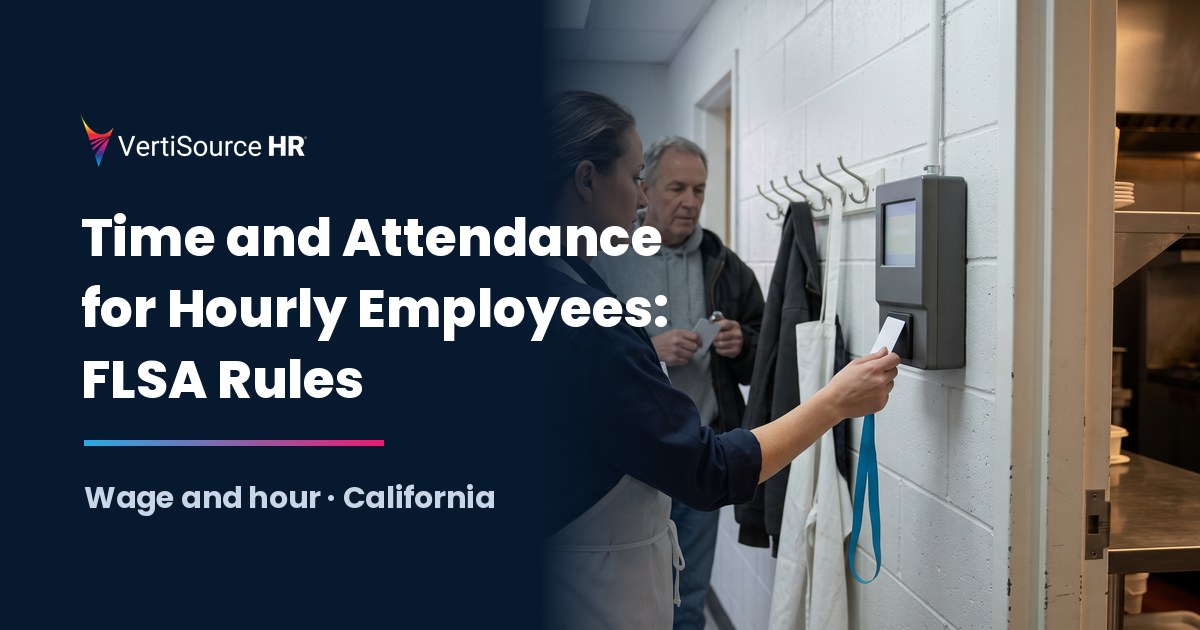
Under the federal Fair Labor Standards Act (FLSA), covered employers must record non-exempt employees’ hours by day and workweek and figure overtime by workweek. Short breaks you offer count as hours worked, and DOL accepts rounding only if it does not underpay people over time.
What does federal law expect you to track?
U.S. Department of Labor (DOL) Fact Sheet #21 lists the records a covered employer keeps for each non-exempt worker, including hours worked each day, total hours each workweek, and the time and day the workweek begins. Keep payroll records at least three years and time cards two years.
Any timekeeping method is acceptable if it is “complete and accurate.” On a fixed schedule, you may record the schedule and note it was followed, but you must record actual hours on days that differ.
Is rounding time punches legal?
Federally, yes, as long as it evens out. In California, we’d turn it off and pay to the minute.
Federal rules (29 CFR 785.48) let you round to the nearest 5 minutes, tenth or quarter hour, as long as over time it doesn’t shortchange people for time they actually worked. California is stricter. Its Supreme Court has already ruled out rounding meal-break punches (Donohue v. AMN Services, 2021). An appeals court went further in Camp v. Home Depot: if your clock records the exact minutes, you owe every one. The state Supreme Court agreed to review that case in 2023 and, as of July 24, 2026, had not ruled, so rounding in California is a bet on how it comes out.
Our time clock feeds payroll directly, overtime is calculated under each state’s own rules, and the clock prompts for each state’s meal and rest breaks. If you’re not sure your current setup pays every minute, we’ll check how you pay overtime and breaks, free.
5-minute check
Pull the October 2026 punches for five hourly employees and compare them with the hours you paid. Where paid hours run below the punches, find out whether that time was work. If the comparison reveals unpaid work, correct the affected pay and check how far the problem extends. Change any rounding rule that underpays employees over time and verify the next payroll.
If people start working before the shift, see our piece on unpaid minutes before a shift.
Do you have to pay for breaks?
Federal law does not require lunch or coffee breaks. When you offer short breaks, usually about 5 to 20 minutes, DOL treats them as hours worked that count toward overtime. California is stricter: it generally requires a paid 10-minute rest period for each 4 hours worked or major fraction of 4 hours. California also generally requires a 30-minute meal period when an employee works more than 5 hours a day, unless the day ends within 6 hours and both sides agree to waive it.
DOL Fact Sheet #22 says bona fide meal periods, typically 30 minutes or more, generally need not be paid, but “the employee must be completely relieved from duty,” including from inactive duties while eating.
An unauthorized break extension need not be counted if you clearly told employees the break’s length and that going over it breaks your rules and will be punished.
Under DOL Fact Sheet #73, most nursing employees have the right to reasonable break time and a place, other than a bathroom, shielded from view to express breast milk at work for up to one year after the child’s birth; employers with fewer than 50 employees may be exempt from the federal rule if compliance would be an undue hardship, though state or local law may give more protection.
How should overtime be counted?
Count overtime by workweek: covered, non-exempt employees get at least time and one-half their regular rate for hours over 40 in a workweek, under DOL Fact Sheet #23. A workweek is a fixed, regularly recurring period of 168 hours that need not match the calendar week.
“Averaging of hours over two or more weeks is not permitted.” Each workweek stands alone, so hours over 40 in one week are overtime even if the second week is short and both weeks fall in one biweekly pay period.
The regular rate includes “all remuneration for employment except certain payments excluded by the Act itself.” DOL Fact Sheet #56C says a bonus is discretionary, and can be left out of the regular rate, only if you alone decide whether to pay it and how much until at or near the end of the period, and no prior contract, agreement or promise leads employees to expect it regularly. Nondiscretionary bonuses, such as attendance, production and safety bonuses, must be included unless another exclusion applies. Our piece on overtime checks at payroll close covers the review side.
DOL or an employee can recover unpaid minimum wage or overtime as back wages plus an equal amount in liquidated damages, according to DOL’s Handy Reference Guide to the FLSA.
Outside this guide: state rules
Some states require daily overtime on top of the federal weekly rule. California generally requires nonexempt employees to be paid one and one-half times the regular rate for hours over eight in a workday and double time for hours over 12 in a workday. DOL’s state tables for meal periods and paid rest periods were last revised January 1, 2023, and can be out of date. Minnesota’s rules changed January 1, 2026: employers must generally allow a meal break of at least 30 minutes when working six or more consecutive hours, and a paid rest break of at least 15 minutes within each four consecutive hours worked. Confirm current rules with your state labor agency. Rules for minors, industry rules and union contracts can also add requirements.
What should you ask a time and attendance provider?
Check your own records, breaks and overtime first, then put the provider questions below to any system you use or consider.
Your records, breaks and overtime check
Questions for any time and attendance provider
How VertiSource HR handles time and attendance
Our time and attendance is synced with our payroll: employees clock in on the web or a phone, managers approve timesheets each week, and approved timesheets flow into the next payroll run. It calculates overtime by state, prompts for state meal and rest breaks, and logs every timesheet edit with who made it, when and why.
Primary sources: 29 CFR 785.48; DOL, Breaks and Meal Periods; DOL Fact Sheet #22: Hours Worked; DOL Fact Sheet #23: Overtime Pay; DOL Fact Sheet #21: Recordkeeping; DOL state meal period table; DOL state paid rest period table; DOL Fact Sheet #56C: Bonuses; Donohue v. AMN Services (Cal. 2021); California Supreme Court to Address Rounding of Employee Time; Minnesota DLI, 2026 meal and rest break changes; Work breaks, rest periods; California Labor Commissioner, Overtime; DOL Fact Sheet #73: Break Time for Nursing Mothers; DOL Handy Reference Guide to the FLSA. Last reviewed November 16, 2026.
Questions employers ask
Do I have to pay employees who clock in early?
Does a working lunch have to be paid?
Do I have to pay overtime I did not approve in advance?
Want a second look at your time tracking?
Talk to our team See our time and attendance
Disclaimer: This content is for general informational and educational purposes only and does not constitute legal, tax, accounting, or professional advice. Consult a qualified attorney or licensed advisor before making employment, payroll, or compliance decisions. VertiSource HR disclaims all liability for actions taken or not taken based on this material.
Have a question on this?
Talk to the VertiSource HR specialist who handles california compliance work every day. No script, no sales drip.
Get your free HR review