OSHA’s Opioid Overdose Fact Sheet: Is Naloxone Required?
OSHA's September 24, 2026 opioid overdose fact sheet is guidance, not a rule. What it recommends on naloxone, storage and training, and how to act on it.
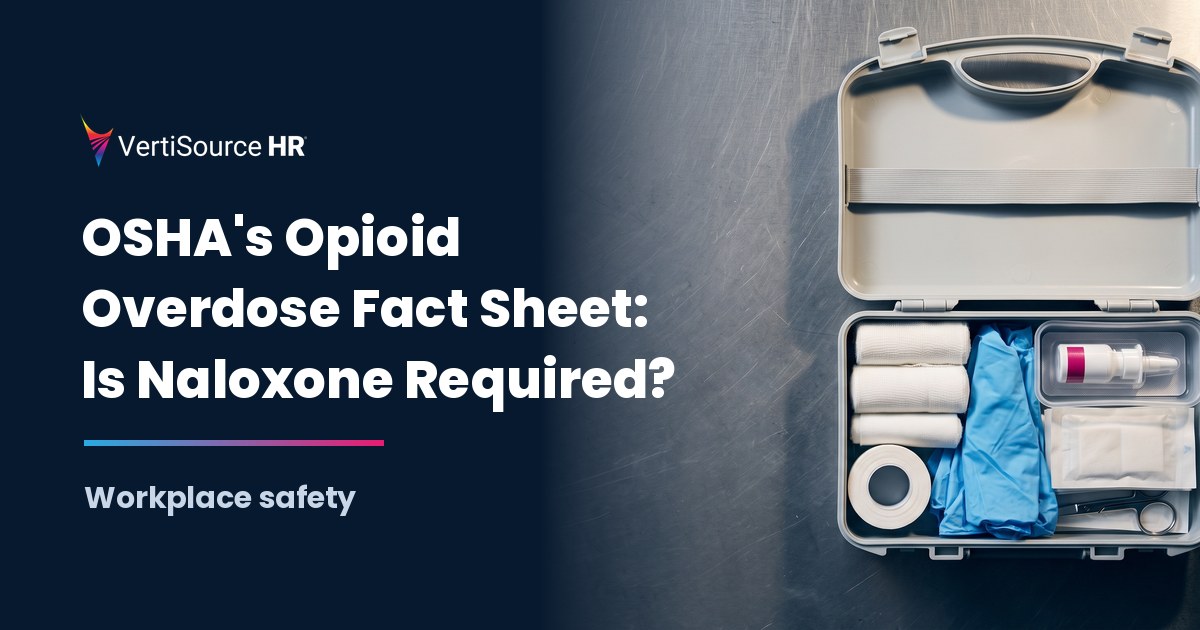
On September 24, 2026, OSHA released a fact sheet, “Opioid Overdose Rescue with Reversal Medications,” on how employers and workers can prepare for an overdose at work. It is guidance, not a new rule, and it recommends keeping reversal medication on hand and suggests considering a voluntary training program.
Quick answer
No. OSHA’s new fact sheet does not create a federal requirement to stock naloxone; it says it “does not impose any new compliance requirements.” It recommends keeping an FDA-approved reversal medication where people can find it quickly, naming someone to manage the supply, and considering a voluntary training program. Check whether your state or industry has its own rules.
What did OSHA release?
A short fact sheet on opioid overdose reversal medications, which OSHA calls OORMs. OSHA’s news release says it is part of the Great American Recovery Initiative.
It covers how the medications work, how employers can get them, how to store and restock them, what to train workers on, and where to find more resources. OSHA names two FDA-approved OORMs: naloxone and nalmefene. Naloxone, commonly known by the brand name Narcan, is a medication the FDA says rapidly reverses the effects of opioid overdose.
Why act on guidance that is not required?
Under the Occupational Safety and Health Act, employers are responsible for providing a safe and healthy workplace, and the fact sheet repeats that point. It also says having reversal medication on hand “can save lives.”
The cost can be low. According to OSHA, some naloxone nasal sprays can be bought without a prescription at pharmacies and other retail or online outlets, and many local and state health departments distribute naloxone at low or no cost.
OSHA also says the medications only work if someone has opioids in their system and will generally have no effect on someone who has not taken opioids.
What does OSHA recommend employers do?
The fact sheet sets no compliance deadline. These four steps follow its recommendations; where we add a practical step of our own, we mark it as our suggestion.
A readiness plan built on OSHA’s fact sheet
What should training cover?
OSHA lists what training should cover. Its topics include the signs of an overdose, how the medication works, step-by-step use, the possible need for more than one dose, withdrawal symptoms, the recovery position, treating people with respect, and linking the person to ongoing care. OSHA says many state and local health departments offer free training. To make this training part of a wider safety culture, see our article on prioritizing safety in the workplace with human resource development.
The list also includes Good Samaritan laws, which protect people who help someone during an overdose. OSHA says employees should know what protections exist in their state, so if you have locations in more than one state, check each one.
Our suggestion: document who was trained and when. If you have California employees and keep training records, see our article on SB 513 and training records in personnel files.
If an overdose happens at work
- Call 911 right away. OSHA says the medication is temporary and is not a replacement for emergency medical care, even if the person regains consciousness.
- Look for the signs. OSHA lists slow or stopped breathing, blue lips, unresponsiveness and pinpoint pupils; a gurgling or snoring sound is a red flag.
- Give the medication and position the person. Follow the product labeling and use the recovery position. Another dose may be needed if the person does not respond to the first dose, or, as OSHA notes, if the medication wears off before responders arrive. Follow the specific product’s instructions on giving another dose. For NARCAN nasal spray, its labeling says to use a new spray for each dose and that doses may be repeated every 2 to 3 minutes until emergency help arrives; other products have their own instructions.
Who can help set this up?
Our suggestion: if you work with a PEO, agree with it in writing who handles each part of this plan. Put any outside safety vendor’s role in writing as well, and decide who at each site owns the kits and the training list.
Small and medium-sized businesses can also get free, confidential advice from OSHA’s On-Site Consultation Program, which gives priority to high-hazard worksites.
Primary sources: OSHA Fact Sheet: Opioid Overdose Rescue with Reversal Medications; OSHA news release, September 24, 2026; FDA: first over-the-counter naloxone nasal spray; NARCAN (naloxone) Nasal Spray labeling, DailyMed (National Library of Medicine). Last reviewed October 5, 2026.
Questions employers ask
Does OSHA require employers to keep Narcan or naloxone at work?
Do employees have to be trained to give the medication?
Where can a small employer get naloxone?
Want help adding this to your safety program?
We help employers turn guidance like this into handbook language, training records and a clear owner at each site.
Have a question on this?
Talk to the VertiSource HR specialist who handles legal news & compliance work every day. No script, no sales drip.
Get your free HR review