
Trump Accounts: the $1,000 head start for kids born 2025 through 2028
Trump Accounts give eligible kids born 2025 to 2028 a $1,000 federal seed, and families can add up to $5,000 a year. See how they work, how they are taxed, and how to claim it.
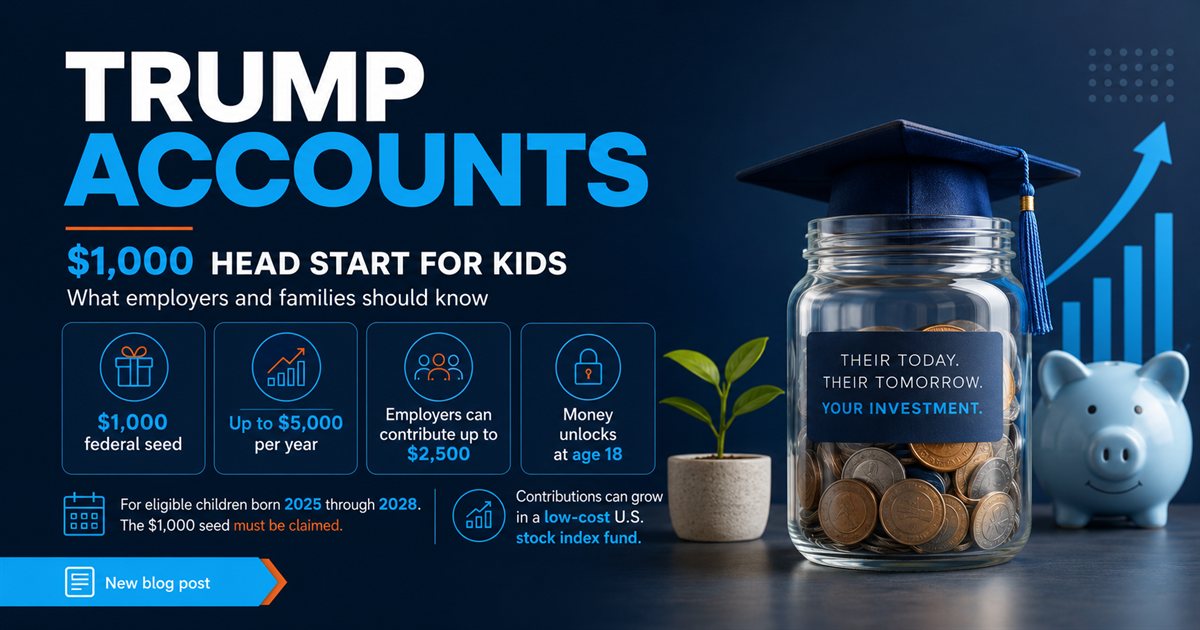
If you had a baby in 2025, the federal government is offering to put $1,000 into an investment account with your child’s name on it. Not a coupon or a tax credit you chase down at filing time, but a real account, invested in the stock market, that can compound for eighteen years before anyone can touch it. It is called a Trump Account. The accounts opened on July 4, 2026, and they now accept contributions.
Featured takeaway
The $1,000 is the starting line, not the whole offer. Families can add up to $5,000 a year on top of it, and an employer is allowed to cover up to $2,500 of that. Left in a low-cost stock index fund, a single seed plus steady yearly deposits can grow into tens of thousands of dollars by the time a child turns 18, which is the first moment any of it can come out.
What a Trump Account actually is
Trump Accounts were created by the One Big Beautiful Bill Act, the tax law signed on July 4, 2025, and they live in a brand new corner of the tax code, Section 530A. The simplest way to picture one is a starter retirement account for a child: money goes in, gets invested in the U.S. stock market, and grows without being taxed along the way. Once the child turns 18, most traditional IRA rules generally apply, though the account stays a Trump Account unless it is moved or handled differently under IRS guidance.
The $1,000 is real, but you have to claim it
The federal seed is set aside for any child who is a U.S. citizen, has a Social Security number, and was born between January 1, 2025 and December 31, 2028. One detail trips people up: the Social Security requirement is on the child, not the parents, and the adult making the election can use either a Social Security number or an ITIN. The money is not deposited automatically, though. A parent or guardian has to make an election in the Trump Accounts app, at trumpaccounts.gov, or on IRS Form 4547, and then activate the account using the instructions Treasury sends. Skip that step and the $1,000 never shows up. The accounts opened on July 4, 2026, and the first $1,000 deposits went out that day. Beginning around October 1, 2026, Treasury also opens an account automatically for eligible children who do not have one yet, but the $1,000 still requires a parent’s election. Under Treasury’s proposed rules, that election is due by December 31 of the year the child turns 17. The seed sits on top of your yearly contribution room, so claiming it costs you nothing.
How much can go in, and who can add it
Once an account is open, up to $5,000 a year can flow into it from just about anyone: parents, grandparents, even family friends. That limit is locked at $5,000 for 2026 and 2027, then rises with inflation. Here is the newer wrinkle for working parents. Employers can now put in up to $2,500 of that $5,000 directly. It is free of federal income tax for the employee, but under the IRS’s August 2026 proposed rules, Social Security, Medicare and federal unemployment (FUTA) taxes still apply. If Treasury opened the account automatically, a parent has to claim it in the Trump Accounts app before family or employer money can go in. A few outside gifts stack on top of the cap entirely. Michael and Susan Dell, for example, pledged $6.25 billion to add $250 for children 10 and under who were born before 2025, and so do not qualify for the $1,000, in ZIP codes with a median household income of $150,000 or less.
The stock market grows the money, but the IRS taxes the gains like a paycheck, not a long-term investment, when it finally comes out.
Where the catch hides: how it is taxed
The investing side is deliberately plain. The law requires the money to sit in a low-fee fund, no more than 0.1% in annual costs, that tracks a broad U.S. stock index like the S&P 500. The fund cannot use leverage, so there is no borrowing to chase bigger returns. The tax side is where families need to pay attention. You do not get a deduction for what you put in, the account grows tax-deferred, and when the money finally comes out it is taxed like a traditional IRA. That means the gains are taxed as ordinary income, at whatever rate your grown child pays on a paycheck, and not at the lower long-term capital-gains rate you might expect from a stock investment. Take taxable money out before age 59½, including earnings, the $1,000 seed and any employer money, and a 10% additional tax can apply on top unless an exception applies.
When your child can actually use it
Nobody can take money out before January 1 of the year the child turns 18, with narrow exceptions like the account holder’s death. After that, most traditional IRA rules apply, which steers the money toward retirement rather than a first car. That long lock is the point: it is built to compound quietly for two decades, not to be raided at graduation.
So is it worth opening one?
For a child born in the eligible window, claiming the $1,000 is close to a no-brainer: it is free and it grows for years. Beyond the seed, a Trump Account is one good option among several. If college is the goal, a 529 plan still offers tax-free withdrawals for tuition. If your child has a part-time job, a custodial Roth IRA and its tax-free growth may come out ahead. The Trump Account’s edge is that it needs no earned income and arrives with that federal head start, and if your employer offers the $2,500, it is worth asking about, the same way you would ask about a retirement match. These are not strictly either-or choices, and many families pair a Trump Account for the early head start with a 529 for school, where withdrawals for qualified education costs can come out tax-free.
What employers should decide before offering Trump Account contributions
The employer contribution is one of the more interesting pieces of this law, and it comes with real setup work. Under Section 128 of the tax code, a company can contribute up to $2,500 per employee each year, and that money can go into the employee’s own Trump Account or into a dependent’s account. The $2,500 is a per-employee figure, not a per-child one, so an employee with three children still shares a single $2,500 limit. It is left out of the employee’s income for federal income tax, though Social Security, Medicare and FUTA taxes still apply, and it counts toward the same $5,000 annual cap that covers family contributions, while the $1,000 federal pilot deposit sits outside that cap. Because employer money and post-tax family money can be treated differently for tax purposes later, payroll needs to track them as separate buckets rather than one running total.
The first decision is how to fund the benefit: a direct company contribution, a salary-reduction arrangement, plain post-tax payroll deductions, or some mix. If you route a dependent’s contributions through a Section 125 cafeteria plan, that takes plan-document updates and payroll coordination. Cafeteria-plan salary reduction works only for a dependent’s account, never the employee’s own. Under the IRS’s proposed rules, Section 128 also requires a separate written plan, reasonable notice to employees, nondiscrimination testing, and an annual statement, and contributions are reported on Form W-2 in box 12 with code TA. On the ERISA question, June 2026 DOL guidance (Technical Release 2026-02) indicates that contributions during the growth period generally will not create an ERISA-covered plan as long as participation is voluntary and the employer stays within the stated conditions, such as not steering the investments or presenting the program as its own retirement plan. That is helpful, but it is not automatic, so confirm your design with advisors rather than assume it.
Thinking about offering Trump Accounts as a benefit?
The $2,500 employer contribution, which is free of federal income tax for the employee, is new enough that many companies are still deciding whether to offer it. If you are weighing Trump Account contributions, VertiSource HR can help you think through payroll setup, benefit communication, plan coordination, and how the new contribution fits with the benefits you already offer.
Trump Accounts: common questions
What is a Trump Account?
A Trump Account is a tax-advantaged savings account for a child under 18, created by the One Big Beautiful Bill Act signed in July 2025. Money contributed to the account is invested in a low-cost fund that tracks a U.S. stock index, and it grows tax-deferred. The federal government adds a one-time $1,000 contribution for eligible children born between 2025 and 2028. Once the child turns 18, traditional IRA rules generally apply to the money.
Who qualifies for the $1,000, and how do I claim it?
The one-time $1,000 federal contribution is available for a child who is a U.S. citizen, has a Social Security number, and was born between January 1, 2025 and December 31, 2028. The Social Security requirement applies to the child, not the parents, and the adult making the election can use a Social Security number or an ITIN. It is not deposited automatically: a parent or guardian must make an election in the Trump Accounts app, at trumpaccounts.gov, or on IRS Form 4547, and then activate the account. Under Treasury’s proposed rules, the election is due by December 31 of the year the child turns 17. The $1,000 does not count against the annual contribution limit.
How are Trump Accounts taxed?
Contributions are made with after-tax dollars and are not deductible. The money grows tax-deferred, so there is no tax while it stays invested. When it is withdrawn, the account is taxed like a traditional IRA: the earnings are taxed as ordinary income rather than at lower long-term capital-gains rates, and a 10% additional tax can apply to taxable amounts taken out before age 59½, unless an exception applies. Your original after-tax contributions come back out tax-free, but the $1,000 seed and any employer contributions are fully taxable when withdrawn.
How is a Trump Account different from a 529 plan or a Roth IRA?
A 529 plan is built for education and offers tax-free withdrawals for qualified school costs, while a Trump Account can be used more broadly but is taxed on its earnings. A Roth IRA offers tax-free growth but requires the child to have earned income and has a higher annual limit, $7,500 in 2026 versus the Trump Account’s $5,000. The Trump Account’s main advantages are that it needs no earned income and includes the one-time $1,000 federal seed for eligible newborns.
Can employers contribute to Trump Accounts?
Yes. Under Section 128 of the tax code, an employer can contribute up to $2,500 per employee per year, and the money can go to the employee’s own Trump Account or to a dependent’s account. That $2,500 is free of federal income tax for the employee, though Social Security, Medicare and FUTA taxes still apply, and it counts toward the $5,000 annual limit for the account, while the $1,000 federal pilot contribution does not. Employer contributions and post-tax family contributions should be tracked separately, since they can be treated differently for tax purposes, and, under the IRS’s proposed rules, a written plan, employee notice and nondiscrimination testing are required, with contributions reported on Form W-2 in box 12, code TA. Employers should coordinate payroll, benefits, and tax advisors before launch.

Disclaimer: This content is for general informational and educational purposes only and does not constitute legal, tax, accounting, or professional advice. Trump Account rules are still being finalized: parts of this article rely on proposed and temporary IRS and Treasury regulations, which can change. Consult a qualified attorney, tax professional, or licensed advisor before making savings, benefits, or tax decisions. VertiSource HR disclaims all liability for actions taken or not taken based on this material.
Have a question on this?
Talk to the VertiSource HR specialist who handles benefits & compensation work every day. No script, no sales drip.
Get your free HR review